
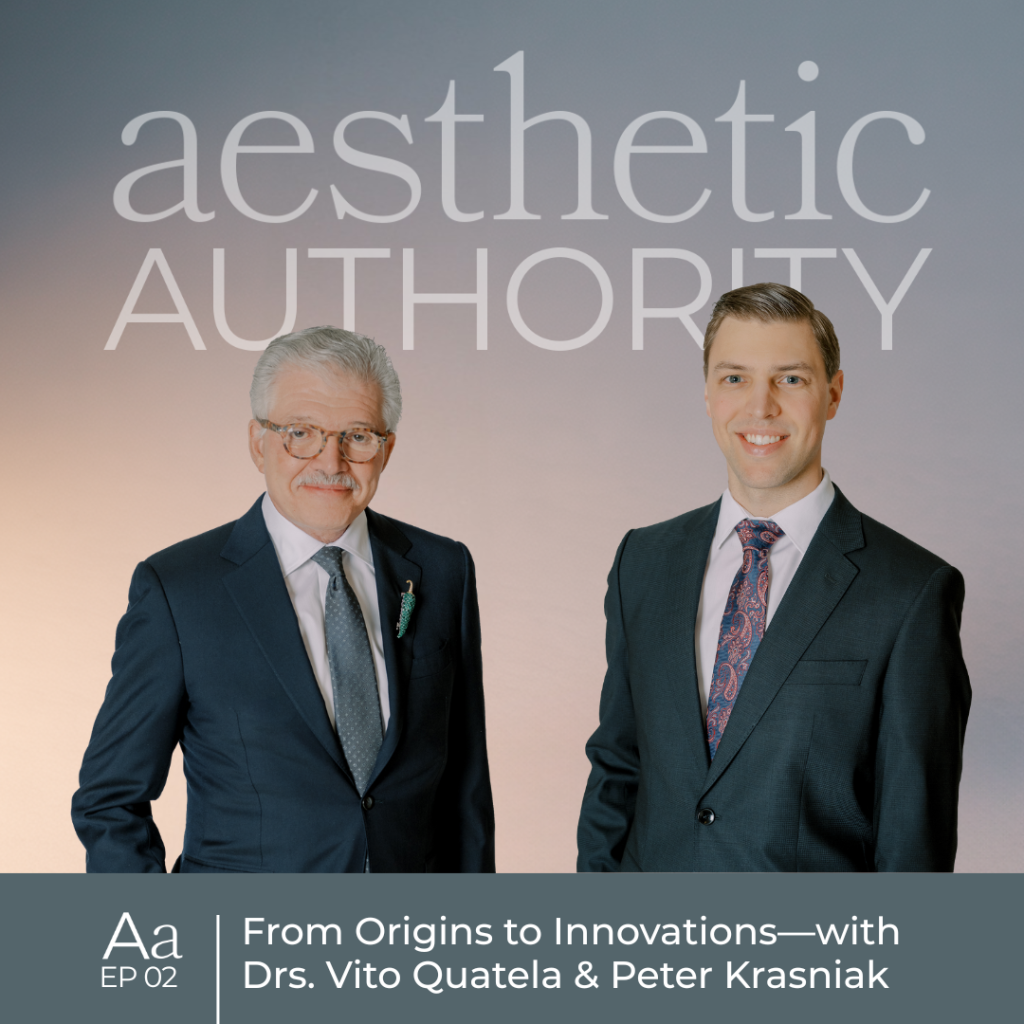
A conversation with Dr. Vito Quatela and Dr. Peter Krasniak
When Dr. Vito Quatela first envisioned what would become the Quatela Center for Plastic Surgery, he saw something that didn’t yet exist in Rochester—a place where world-class surgical expertise met comprehensive aesthetic care, all under one roof. Nearly three decades later, that vision has evolved into something even more profound: a destination where specialized excellence and exceptional patient experience create truly transformative journeys.
The Foundation: Where Passion Meets Purpose
Dr. Quatela’s path to founding the Quatela Center began, surprisingly, with pediatrics. “I was going to be a pediatrician,” he recalls. “Then I found myself on a two-week rotation in otolaryngology and got interested in that.”
What followed was a journey shaped by mentors who recognized his potential and guided his development. A residency director who was also a facial plastic surgeon took him under his wing, leading to weekend sessions in private practice and eventually a fellowship in facial plastic surgery.
“I’m always grateful to all the mentors that have crossed my path,” Dr. Quatela reflects. These early influences would shape not just his surgical approach, but his entire vision for what a plastic surgery practice could become.
The architectural inspiration for the Lindsay House itself came from unexpected sources—a mentor’s antebellum mansion in Louisiana and a surgical resident’s father’s antique oak-paneled office in Vermont. These experiences planted seeds that would later bloom into the distinctive aesthetic that defines the Quatela Center today.
From Academic Medicine to Entrepreneurial Vision
For fifteen years, Dr. Quatela thrived in academic medicine at the University of Rochester, deeply invested in resident education. Yet something wasn’t quite aligned.
“I realized very quickly that I was an entrepreneur trapped in an academic body,” he admits with characteristic candor. “But it took me fifteen years to say, okay, I need to do something else.”
That realization led to the Lindsay House—though the university gave him remarkable leeway to pursue this vision during his final five years on faculty, even moving his office from the university to the historic mansion while maintaining his full-time attending position.
What drove this transition wasn’t just ambition. Dr. Quatela possesses what he calls a unique ability for 3D problem solving. “If you put me in an OR with a patient with a hole in their face, I’m turned on about how to solve it,” he explains. “But if you put me in a room with an architect and blueprints, I’m equally enthralled.”
This parallel passion for surgical precision and spatial design would become integral to creating the comprehensive patient experience that defines the Quatela Center.
The One-Stop Shop Vision
From the beginning, Dr. Quatela’s vision extended far beyond a traditional plastic surgery practice.
“What I had envisioned was a one-stop shop where you came and in this place, we took hair off your body and put it on your body. We do everything from a minor peel to a very deep laser resurfacing, breasts, body—anything you wanted aesthetic, whether from something very minor to something very complex.”
This comprehensive approach required specific elements: a dedicated surgery center for complete control over the surgical experience, recovery facilities for patients traveling from distance, and a medical spa for both pre-surgical preparation and post-surgical maintenance.
“We were the second medical spa in Rochester to be developed,” Dr. Quatela notes. “But I developed it really for aftercare for patients, and it’s continued to serve in that manner.”
The vision was ambitious—perhaps too ambitious to realize immediately. The practice began with facial plastic surgery exclusively, and it would be eight years before Dr. Quatela brought on his first plastic surgeon partner to expand into body procedures.
“You can’t sustain an OR with one surgeon,” he explains pragmatically. “I had to find surgeons to fill the OR, and it wasn’t going to happen right from within our practice initially.”
The Power of Partnership
When the time came to expand, Dr. Quatela approached the decision with characteristic thoughtfulness. His first partner, Dr. William Koenig, came after an exhaustive search and a day spent observing him in surgery.
“I was so worried about maintaining the brand of excellence we have here,” Dr. Quatela recalls. “I went down to Sayre, Pennsylvania, and watched him do surgery for a day.”
The connection was immediate—both had attended Northwestern Medical School at different times, creating an unexpected bond. More importantly, Dr. Koenig’s surgical skill and approach aligned perfectly with the Quatela philosophy.
“He was an outstanding person, an outstanding surgeon. I was so blessed to have him as a partner for so many years,” Dr. Quatela reflects. “That outcome and that relationship showed me we could grow this—why let him retire and not make this bigger than just me?”
Dr. Koenig’s partnership lasted nearly twenty years, establishing the collaborative model that would define the practice’s future growth.
The Fellowship Program: Teaching as Transformation
While building the physical practice, Dr. Quatela was simultaneously investing in the future of facial plastic surgery through education. His fellowship program, which began in 1995, has become one of his most profound sources of professional satisfaction.
“When I look at all the things I’ve done—building ambulatory surgery centers, being president of the academy, all different things—the thing that has given me the most pleasure and the most reward has been the fellowship program,” he shares. “I’m on my 31st fellow, and they’re like my children.”
The fellowship program creates a unique dynamic that benefits both teacher and student. Fellows push their mentors to continually innovate and question established methods.
“I didn’t have all the answers for my first fellow,” Dr. Quatela admits. “I would say, ‘This is how I was taught.’ But then you develop a reason, and sometimes your fellows change how you think about it. The teacher becomes the pupil.”
This two-way exchange of knowledge continues long after fellowship ends. A gathering of his fellows in Idaho featured lectures on “everything I do now that I didn’t learn in fellowship.”
“I was taking notes like a madman,” Dr. Quatela laughs. “The fellowship has been an amazing thing.”
Creating a Pipeline of Excellence
The fellowship program has yielded an unexpected benefit: creating a pipeline of exceptional surgeons who already embody the Quatela philosophy. Both Dr. Heather Lee and Dr. Alex Montague completed their fellowships under Dr. Quatela before joining the practice.
“It’s probably easier to assimilate a prior fellow than someone you completely didn’t know,” Dr. Quatela explains. “It was like bringing back one of my children to the practice. I knew everything about them. There were no surprises.”
This continuity ensures that the practice’s standards and approach remain consistent even as it grows. “When I see that about a third of my patient log is really in Dr. Lee’s schedule now, that warms my heart,” he shares. “It tells me that it isn’t just about me—it’s about the quality and excellence of the work exemplified in all the surgeons here.”
The Arrival of Dr. Krasniak
When Dr. Koenig announced his retirement, the practice faced a pivotal decision. Dr. Peter Krasniak, the newest surgeon to join the team, brought impressive credentials and experience, but the true test came during his trial period working alongside Dr. Koenig.
“We went through the usual process—looking at letters of recommendation, where you trained, your experience, case numbers. You met the grade in every way,” Dr. Quatela tells Dr. Krasniak. “We interviewed you, and personality-wise, you’re amazing. But the proof is in the pudding.”
The validation came quickly. “I think you were only here for a month, and Dr. Koenig came up to me and said, ‘This is absolutely the right guy,'” Dr. Quatela recalls. “For him to say that was amazing. I started sleeping better because you just don’t know until it all comes together.”
Dr. Krasniak embodies the core values that define the Quatela culture: a serious approach to work, kindness toward patients and colleagues, a can-do attitude, and genuine passion for the craft.
The Philosophy of Specialization
A defining characteristic of the Quatela Center is its commitment to focused expertise. Rather than practicing as generalists, each surgeon specializes deeply in their area of focus.
“We’re very focused on what we do, and we’re not generalists,” Dr. Quatela emphasizes. “I believe that every step of the way, the more focused we are, the better we’re going to get at it.”
This philosophy extends beyond the surgeons to every level of the practice. Medical spa staff members specialize in particular treatments and technologies. Hair transplant technicians focus exclusively on their highly technical craft. Even within surgical specialties, there’s recognition that further subspecialization may evolve.
“We may end up with a facial plastic surgeon who just does noses,” Dr. Quatela muses. “And the person who goes to them for their nose is probably going to get the latest and greatest.”
The evidence for this approach is clear. “You can’t be an expert at something if you’re not doing it every single day,” he notes. “The more you focus on your craft, the better you’re going to get at it.”
Innovation as a Constant
Despite his years of experience, Dr. Quatela maintains an unwavering commitment to innovation and continuous learning.
“A fundamental thing about innovation is that you have to be active. You have to go to meetings, read papers, have a willingness to learn forever—not just when you finish your training,” he emphasizes. “I always say that the day I stop innovating is the day I stop practicing.”
Sometimes innovation means trying something entirely new. Other times, it means revisiting older techniques with fresh insights. “I’ll do a technique that maybe I did fifteen years ago, but with a different twist—the thing that was missing that makes it better.”
This commitment extends across the practice. Dr. Quatela recently attended a preservation rhinoplasty meeting to learn emerging techniques. “Here I am, going to learn what’s involved there,” he says. “I think that’s the way it should be.”
The collaborative structure of the practice accelerates innovation. Unlike solo practitioners, Quatela surgeons can immediately discuss new techniques and approaches with colleagues who understand the nuances.
“It’s amazing when we have a difficult case and we exchange ideas—that can happen under one roof without picking up the phone and calling a colleague,” Dr. Quatela observes.
Controlling the Complete Experience
A pivotal moment in the practice’s evolution came with the establishment of the on-site surgery center—originally built in 1995, though licensure didn’t come until 2000 when regulations changed.
The motivation wasn’t just convenience. It was about controlling every aspect of the patient experience.
“I needed to control the touchpoints,” Dr. Quatela explains. He shares a story that crystallized this need: a patient who underwent a facelift at a hospital ended up recovering next to her best friend, who was having neurosurgery for a brain tumor.
“That woman went into a depression about how self-conscious she was about having cosmetic surgery while her best friend was fighting for her life,” he recalls. “Did I have any control that they were going to end up side by side? No.”
Once the surgery center received full approval, the vision crystallized. “I said, okay, we can control every touchpoint for this patient. That’s when all the pieces came together.”
This comprehensive approach means patients experience consistency from their first consultation through their final follow-up appointment. They see familiar faces, navigate familiar spaces, and receive care guided by unified protocols and philosophy.
The Collaborative Advantage
The benefits of the comprehensive, collaborative model reveal themselves daily in patient care. When Dr. Krasniak sees patients seeking body contouring who also express interest in facial procedures, he can seamlessly connect them with Dr. Quatela, Dr. Lee, or Dr. Montague—no need to research new practices or start over with unfamiliar providers.
“Having all that be able to happen in the same place helps patients,” Dr. Krasniak observes. “They’re looking for familiarity and continuity. The number of patients who just like coming here because they’re so familiar with it—when I recommend they see someone else for something outside my area, you can see the sigh of relief because they have confidence in the place.”
This creates a natural funnel that benefits patients and practice alike. Someone visiting the medical spa for CoolSculpting might be referred to Dr. Krasniak when surgery proves a better option. A patient seeing Dr. Lee for facial rejuvenation might discover the medical spa’s maintenance treatments extend their results.
The education flows in all directions. Physicians teach medical spa staff about the limits of non-surgical treatments and when to recommend surgical consultation. This level of integrated knowledge is impossible in standalone medical spas without physician involvement.
“When you take your average med spa that doesn’t even have a physician present on site, the amount of education we as physicians give the med spa staff is invaluable,” Dr. Quatela notes. “That makes that spa staff so much more capable in their recommendations.”
Looking Forward
As the conversation turns to the future, Dr. Quatela’s vision remains characteristically ambitious yet grounded.
Despite concerns about artificial intelligence and robotics transforming various industries, he sees surgical artistry remaining fundamentally human. “The one thing AI can’t do still today—robots don’t have dexterity. If you watch them folding a towel, it’s a project. I don’t think they’ll ever do what we do.”
The specialty itself continues growing, driven by enduring human interest in aesthetic enhancement. Even economic downturns haven’t derailed the practice’s growth.
“I’ve learned that people value what we do. They may not do as much if we’re in a downturn economy, but they’ll still do something,” Dr. Quatela reflects. “In my career, we’ve gone through at least four downturn economies, and we’ve never had a downturn year.”
Patients adjust their approach—perhaps choosing injectables instead of surgery, or spreading procedures across multiple years—but they maintain their investment in how they look and feel.
The most exciting growth opportunity lies in expanding beyond the Rochester catchment area. The practice is already seeing this transformation.
“Anytime I walk in the operating room, I ask where the patient is from this week,” Dr. Quatela shares. “Tuesday’s facelift was from Wyoming. Wednesday’s was from Connecticut. Yesterday’s was from Fairport. That’s our future.”
This geographic expansion isn’t about becoming larger than the Rochester area can sustain—it’s about becoming a destination where patients travel because the experience and expertise justify the journey.
“The power of the draw, knowing that it’s safe, that you have excellent care—that’s where the growth is,” Dr. Quatela explains. “It’s going to be outside this catchment area.”
For Dr. Krasniak, who has experienced this firsthand since joining the practice, the model is already proving successful. “Even in my time here, I’ve had patients come for surgery from Connecticut, plenty from Pennsylvania. People will travel for value.”
Creating Uplifting Experiences That Change Lives
As the conversation concludes, what emerges is a portrait of something rare in modern healthcare: a practice built methodically over nearly three decades, where every decision—from architectural details to surgeon recruitment—serves a unified vision of excellence.
The Lindsay House stands as physical embodiment of Dr. Quatela’s philosophy: combining historic elegance with cutting-edge capabilities, honoring tradition while embracing innovation, maintaining the warmth of personalized care while leveraging the advantages of collaborative practice.
“If I’m not here, the brand and the quality will go on,” Dr. Quatela says with quiet confidence. “That’s all I can hope for. Twenty years from now, I want people to say, ‘That place is great. No matter what you do there, it’s going to be excellent.'”
That legacy lives in the surgeons he’s trained, the team he’s built, and the thousands of patients whose lives have been transformed not just through surgical skill, but through the complete experience of exceptional care.
For patients considering aesthetic procedures, the Quatela Center story offers reassurance that such comprehensive excellence is possible—and that the journey toward feeling like your best self can be guided by expertise, innovation, and genuine care at every touchpoint.
“We’ve built the groundwork,” Dr. Quatela concludes. “If everyone is as careful as we were in selecting team members, the practice will continue to grow and thrive.”
From one surgeon’s vision to a team of five specialized experts, from a historic mansion to a comprehensive aesthetic destination, the Quatela Center exemplifies what happens when surgical artistry meets entrepreneurial vision—and when both are guided by an unwavering commitment to creating uplifting experiences that truly change lives.
Leave a Reply