
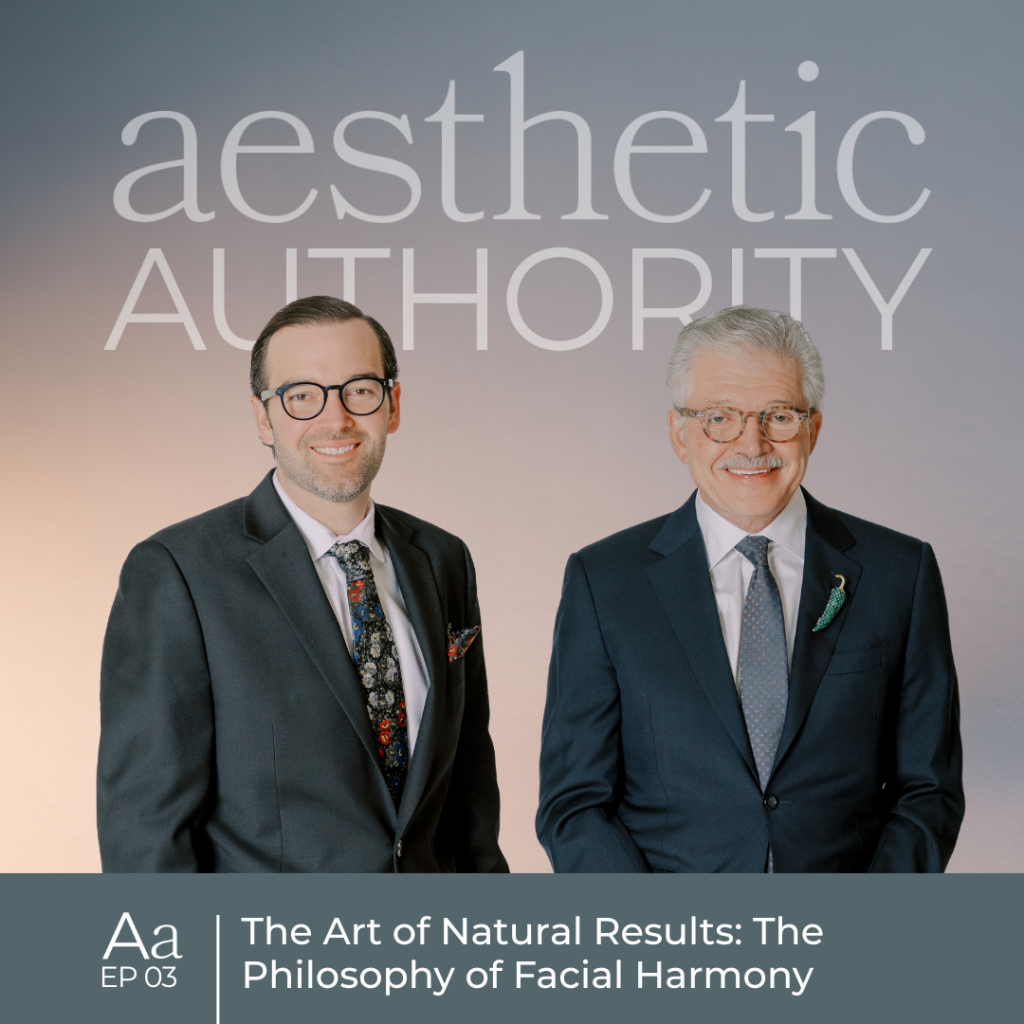
A conversation with Dr. Vito Quatela and Dr. Alex Montague
In the world of aesthetic surgery, perhaps no phrase is repeated more often than, “I want to look natural.” Yet what does “natural” truly mean when it comes to plastic surgery? In a revealing conversation between Dr. Vito Quatela, triple board-certified facial plastic surgeon and founder of the Quatela Center for Plastic Surgery, and Dr. Alex Montague, one of the practice’s double board-certified facial plastic surgeons, the complexity—and artistry—behind natural results comes into sharp focus.
The Paradox of Natural Surgery
“Everybody wants a conservative surgery until they get one,” Dr. Montague quotes from prominent surgeon Neil Gordon, capturing one of the field’s most persistent misconceptions.
This paradox lies at the heart of achieving truly natural results: conservative surgery doesn’t necessarily equal natural-looking surgery. In fact, sometimes the opposite is true.
“We do aggressive surgery here,” Dr. Montague explains, “but that’s in service of looking natural, because aggression at the right time is actually what you need to obtain a natural result.”
Consider the patient who requests “just a little tuck here or there.” While surgically possible, such minimal intervention often fails to address the underlying anatomical changes that created the concern in the first place. The result? A face that might look slightly better but still appears operated on—or worse, appears asymmetric or incomplete.
What Makes Results Look Unnatural?
Both surgeons emphasize that truly unnatural results typically stem from surgical errors rather than ambitious goals.
“When someone comes in and says they don’t want to look like so-and-so, and I look at that result, I might see that the nose was scooped out too much, or the face has a ripple at the corner,” Dr. Quatela explains. “Those are errors in surgery.”
Specific technical mistakes create telltale signs of surgery:
- Excessive tension at the earlobes, creating stretched, “trophy handle” ears
- Too much tension around the eyes, permanently altering their shape
- Over-removal of fat, creating hollowed or skeletal appearances
- Improper vectoring of tissue, causing unnatural contours
The eyes present particular challenges. Research shows people spend approximately 80% of their time looking at someone’s eyes during conversation, with the remainder focused on the lips. The neck, despite often being dramatically improved through surgery, receives far less visual attention.
“If you change someone’s eyes permanently in a way that doesn’t look natural, that’s a huge tip-off that something has been done,” Dr. Quatela observes.
The Surprising Culprit: Not Surgery
When the conversation turns to celebrity transformations and obviously “done” appearances, both surgeons reach an unexpected consensus: the most unnatural results they observe aren’t coming from the operating room.
“The really, really unnatural results are coming in the filler space and not from surgical results,” Dr. Montague asserts. “The biggest culprit is fillers and overdone Botox when it comes to taking someone’s natural beauty and changing it so it’s unnatural.”
Dr. Quatela has developed an elegant solution for patients seeking overfilled lips: calipers and classical proportions.
“I actually pull out calipers and say Leonardo da Vinci used these,” he explains. “Your lower lip should be 1.6 times your upper lip. I measure and show them that if they make their lower lip as wide as they want, it’s going to be out of balance—wider than their nose, their eyes, everything.”
This education in classical facial harmony often helps patients understand why their desired look might actually appear less beautiful than their natural proportions.
The Identity Paradox
Perhaps the most profound challenge in aesthetic surgery involves preserving a patient’s identity while improving their appearance. Patients frequently express this seemingly contradictory desire: “I want this to look different, but I don’t want to look different.”
Dr. Montague shares a transformative case that illuminated this concept. A patient sought rhinoplasty for her prominent dorsal hump—the bump along the bridge of her nose. During computer imaging, Dr. Montague created what he considered a beautiful profile with the hump completely removed.
The patient’s response surprised him. She didn’t feel comfortable with the transformation. After discussion, she revealed that while she disliked her dorsal hump, removing it entirely would erase a feature that connected her to family members and formed part of her identity.
“We redid the imaging, keeping some subtle curvature to her dorsal hump, and she loved it,” Dr. Montague recalls. “She is probably my happiest rhinoplasty patient to date because she kept her identity while getting the change she wanted.”
Dr. Quatela faced an even more challenging version of this scenario early in his career—before modern computer imaging made such conversations possible.
After performing what he considered a beautiful rhinoplasty with a chin implant, his patient sank into severe depression. “She felt like she lost her persona and who she was,” he recalls. The situation required removing the chin implant and psychiatric consultation. The patient eventually accepted—and even loved—the result, returning a year later to replace the chin implant.
“That concept of someone accepting change is really difficult,” Dr. Quatela reflects. “Morphing technology has really helped. I don’t use it as a sales tool—I use it to check for that patient who really doesn’t want to lose a little bit of themselves.”
The Symmetry Myth
Another persistent misconception involves the pursuit of perfect symmetry. Patients frequently arrive seeking to correct perceived asymmetries in their facial features.
“About 90% of the faces I look at are asymmetric,” Dr. Quatela notes. “If I took half of their face and made two right halves or two left halves, one would be wide and one would be skinny.”
These asymmetries extend beyond soft tissue to the very structure of the skull—one orbital socket might differ in shape from the other, one side of the jaw might be slightly larger. These variations are fundamentally normal.
Dr. Montague employed software that could mirror one side of a patient’s face to create perfect symmetry. “No matter where you placed the cursor, you kind of looked like an alien,” he observes. “Perfect symmetry is not achievable and it’s not really how we’re supposed to look.”
The pursuit of symmetry can actually create unnaturalness by fighting against a patient’s inherent structure. When patients focus excessively on minor asymmetries, preoperative photographs become invaluable.
“I can’t tell you how many people postoperatively will look at themselves closer than they did preoperatively and say their right cheek is more swollen,” Dr. Quatela shares. “Then you bring up the preoperative pictures, and sure enough, her right cheek was bigger than her left to begin with.”
How Expectations Have Evolved
Over his decades of practice, Dr. Quatela has witnessed a fundamental shift in patient expectations.
“In the 1990s, people would come in at 65 and say, ‘I’d like to look more like when I was 55,'” he recalls. “You’d show them a picture from that time, say you could achieve it, and you did. It wasn’t hard.”
Today’s reality is markedly different. Advances in technique—particularly in neck contouring—have created possibilities that didn’t exist decades ago. Where traditional facelift focused purely on lifting descended tissue, modern approaches incorporate extensive contouring: reducing prominent submandibular glands, modifying digestive muscles, performing complex subplatysmal work beneath the neck muscle.
“Today, because we’ve become more aggressive, the neck can look better than it did 15 years ago—maybe even better than when they were 25 if they had a genetically full neck,” Dr. Quatela explains. “People want to look better than they ever did, and that’s a big change.”
This evolution means patients rarely seek to simply turn back the clock. They’re looking for optimization beyond what nature originally provided.
The Balance of Aggression and Delicacy
Achieving natural results requires surgical judgment about when to be aggressive and when to exercise restraint.
Dr. Montague illustrates this with deep plane facelift technique: “There are times when you need to pull really hard on tissue if you’re lifting the deep plane and the SMAS [superficial musculoaponeurotic system] below the skin. That’s where you want to be aggressive with your suturing techniques. However, when you’re manipulating the skin over top of that, you want to be very gentle to avoid complications like pixie ear deformity.”
This principle extends throughout facial surgery. The vector—direction of pull—and tension applied to different tissue layers determines whether results appear natural or operated.
Dr. Montague shares a case that demonstrates this principle: a patient who’d undergone facelift elsewhere felt she looked unnatural, as though she’d obviously had surgery. The solution? A more aggressive facelift.
“I removed part of her submandibular glands, some digastric muscle, did extensive subplatysmal work to clean up the neck and give her a crisper jawline,” he explains. “In doing so, it actually turned back the clock in a more natural way that she didn’t have after her first facelift.”
The Evolution from Reconstruction to Aesthetics
Dr. Montague reflects on how the field’s origins inform current practice. Plastic surgery began not in the cosmetic realm but in reconstruction—particularly treating horrific injuries from world wars.
“Everything the forefathers of our field did was in service of making it look like the injury never happened,” he observes. “That has carried into this cosmetic space where we’re trying to make it look like the thing that happened—in this case aging rather than war injury—didn’t happen.”
This heritage explains why every technique aims toward invisibility: hidden incisions, tension-free skin closure, preservation of natural contours. The goal isn’t transformation into someone else, but restoration of oneself.
The Role of Technology—For Better and Worse
Modern technology has both enhanced patient education and complicated expectations. Computer morphing allows surgeons and patients to preview potential results, creating shared understanding before surgery begins.
Yet the same technology that aids consultation can create unrealistic expectations. Filters on smartphones allow instant “correction” of features, creating idealized versions of oneself that may not be surgically achievable.
“People think if you can do it on Photoshop, you can do it in the operating room,” Dr. Montague notes. “Sometimes that’s true, but a lot of times it is not.”
The proliferation of before-and-after photos on social media has introduced another complication: distinguishing real results from AI-generated images. Dr. Quatela recently spent considerable time on social media explaining that a particularly dramatic neck transformation was genuinely surgical, not artificially created.
“I now look at some results, especially from abroad, and question whether it’s AI,” he admits.
The Lifelong Relationship
Both surgeons emphasize that surgery represents one milestone in an ongoing relationship rather than a final solution.
“We’re lifting that same old fabric,” Dr. Quatela tells patients. “We’re not changing the fabric. If you’re wearing a cable knit sweater, you can stretch the folds out, but the cable knits remain.”
This means addressing texture through ongoing treatments: laser resurfacing for skin quality, strategic fillers for areas that can’t be surgically addressed without appearing unnatural, neuromodulators like Botox for dynamic expression lines.
“I chose this specialty for the ongoing relationships,” Dr. Quatela reflects. “I have patients I’ve honestly known for 40 years. They come back for filler, and what you do changes over time. You never repeat exactly what you did the first time because certain things last longer than others.”
Interestingly, Dr. Quatela has observed that filler requirements often decrease as patients age into their eighties and nineties. “I think there’s a stimulation of their own collagen,” he explains. “But I also think at a certain point it just keeps things great, and I’ve seen skin quality get better.”
The medical spa plays a crucial role in this continuum. Services like HydraFacials for enlarged pores, superficial lasers for skin regeneration, and ongoing skincare analysis maintain the foundation that surgical results build upon.
“There are things that don’t fall in the realm of what we do surgically,” Dr. Montague acknowledges. “I lean heavily on the spa for continued maintenance.”
Beyond Rochester: The Advantage of Place
Both surgeons acknowledge that practicing in Rochester provides certain advantages when it comes to natural results.
“This is a blessing of practicing in a place like Rochester,” Dr. Montague observes. “We’re not on the coasts, and Rochester has mostly normal folks with normal aesthetics who just want to look like themselves, but younger.”
This doesn’t mean challenging cases never arise, but the baseline expectation tends toward natural enhancement rather than dramatic transformation—creating alignment between what surgeons can beautifully achieve and what patients genuinely desire.
The Teacher and the Student
The conversation concludes with a reflection on mentorship and the evolution of surgical knowledge. Dr. Montague, who trained under Dr. Quatela as a fellow before joining the practice, notes how their relationship has evolved.
“There were times when I was a little gnat in your ear, asking all these questions while you were operating, trying to soak up all the knowledge,” he recalls. “Now it’s so much fun to have my own perspective and add something to the conversation.”
Dr. Quatela’s response captures the essence of how excellence perpetuates itself: “In every instance of teaching, the teacher becomes the pupil. As much as you’ve learned from me, I’m learning every day from you, from Heather, from everyone here.”
This commitment to continuous learning—evident in Dr. Quatela’s three decades of practice—ensures that techniques evolve, outcomes improve, and the definition of “natural” adapts to serve patients’ genuine goals while honoring their intrinsic beauty.
What Natural Really Means
After exploring the nuances of natural results, what emerges is a sophisticated definition far removed from “conservative” or “minimal” surgery.
Natural results mean:
- Surgical precision that leaves no obvious signs of intervention
- Anatomical understanding that addresses underlying structure, not just surface appearance
- Aggressive technique applied with delicate execution
- Preservation of facial identity while enhancing beauty
- Acceptance of inherent asymmetry rather than pursuit of impossible perfection
- Results that make you look refreshed and rested, not obviously altered
- Outcomes that prompt “You look great!” rather than “Did you have something done?”
Most importantly, natural results mean respecting who you are while enhancing how you appear—turning back time without erasing identity, correcting concerns without creating new ones, and achieving harmony that feels inherent rather than imposed.
At the Quatela Center for Plastic Surgery, this philosophy guides every consultation, every surgical plan, every technical decision made in the operating room. It’s an art informed by science, refined through decades of experience, and perpetuated through mentorship that ensures the next generation of surgeons understands what natural truly means.
Leave a Reply