
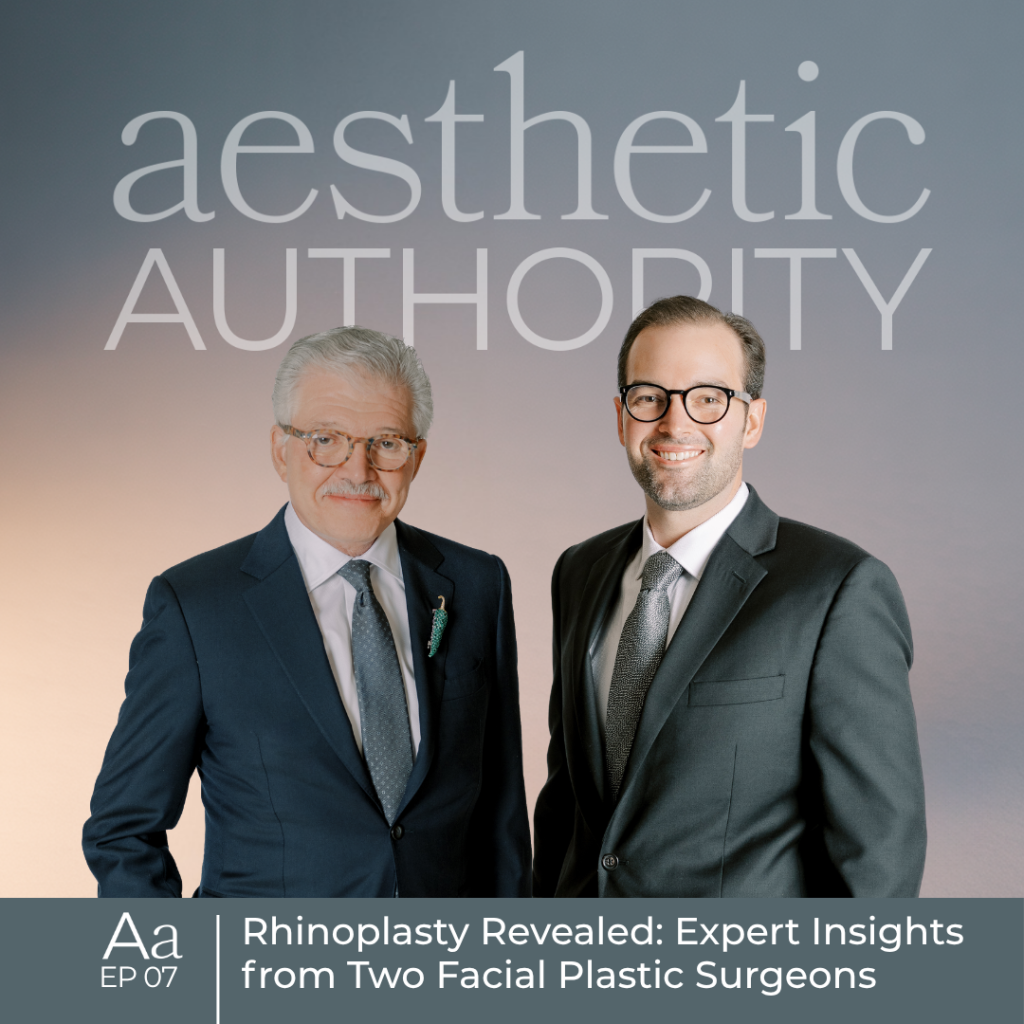
A conversation between Dr. Vito Quatela and Dr. Alex Montague
Of all the procedures performed in facial plastic surgery, none carries quite the complexity—or the transformative power—of rhinoplasty. In a candid conversation between Dr. Vito Quatela and Dr. Alex Montague, both surgeons explore why this centerpiece of the face demands such extraordinary precision, and how decades of surgical evolution have made today’s results more natural and predictable than ever before.
The Most Intimidating Procedure
Even accomplished surgeons remember their early uncertainty with rhinoplasty. “It was the thing that intimidated me the most as a surgeon,” Dr. Montague admits, reflecting on his training years. “I remember talking to you many times about being nervous to take on certain cases.”
Dr. Quatela, despite decades of experience, shares a similar history. “Rhinoplasty was as intimidating to me as it was to you,” he confirms. “It’s one of those things that is so complex, and sometimes you don’t know how complex it is until you get into it. I can’t tell you how many times I’ve looked at a nose and thought, ‘Oh, this is gonna be easy,’ and then two hours later, it wasn’t easy.”
This complexity stems from the nose’s unique position as what both surgeons call “literally the centerpiece” of the face. Unlike other areas that can be concealed with clothing or styling, the nose remains completely exposed. Any imperfection, scarring that doesn’t look quite right, swelling that lingers, is immediately visible to the world.
“Patients are super aware of that, so that’s why they’re intimidated on their side,” Dr. Montague explains. “But then also as surgeons, we’re aware of that because we feel like we don’t have a good fallback position. It has to be right.”
Why the Nose Changes Everything
When asked about the single most impactful aesthetic change possible in facial surgery, both surgeons immediately point to the nose. Yet what makes this fascinating is the disconnect between the scale of surgical adjustment and the magnitude of visual transformation.
“You’re not making big changes technically, but the changes that result are sort of monumental,” Dr. Quatela observes.
This impact extends beyond the nose itself. Facial proportions, hairline position, chin projection—all of these elements interact with nasal length, rotation, and projection to create overall facial harmony. A rhinoplasty doesn’t exist in isolation; it recalibrates the entire facial relationship.
Perhaps most importantly, both surgeons emphasize a crucial distinction: rhinoplasty is fundamentally different from aging-face procedures. “It’s not fundamentally an aging face procedure,” Dr. Montague explains. “It’s changing the structural components of the face and changing the facial harmony in a way the patient sort of never had, as opposed to maybe restoring a jawline the patient used to have—just turning back the clock.”
This distinction matters enormously for patient expectations. While a facelift restores what time has changed, rhinoplasty creates something new, requiring patients to think differently about their transformation.
Why Millimeters Matter
The complexity of rhinoplasty lies partly in the biological variables surgeons cannot fully assess until surgery begins.
“The skin envelope,” Dr. Quatela explains, using a memorable analogy. “You either have a down blanket or you have a bedroom sheet. If you have a bedroom sheet, all the imperfections show through. If you have a down blanket, all the nice things we do to improve the structure don’t show through.”
Beyond skin thickness, cartilage presents its own variables. “All cartilage is not the same,” Dr. Quatela notes. “Some is stiff, some is soft. Some has good structural integrity, and others does not.” Bone density varies too, affecting how easily structures can be manipulated during surgery.
These individual variations explain why precision matters so intensely in rhinoplasty, far more than in procedures like facelift surgery. “You can rotate someone too much, meaning the nasal tip looks too lifted,” Dr. Montague explains. “If it’s a millimeter too high, it can often look overdone or unnatural.”
This precision requirement transforms the surgical approach itself. Rather than following predetermined steps to completion, rhinoplasty demands constant reassessment. “It’s very much a tweak-it-as-you-go sort of operation,” Dr. Montague describes, “as opposed to going through the steps and it’s done.”
Dr. Quatela compares the process to dominoes: “When you make one maneuver, it affects your next maneuver. If you do it in a standard sequence, it almost creates the next step.” A millimeter adjustment on one side might create an unexpected change elsewhere, requiring surgeons to step back, reassess, and adapt continuously throughout the procedure.
The Truth About Recovery Timeline
Perhaps no aspect of rhinoplasty generates more confusion than the question of when results become “final.” The standard answer, one year, represents an oversimplification that both surgeons address candidly.
“I’ve noticed this trend,” Dr. Montague shares. “I think the older the surgeon, the longer they think the results take to be final. Because you’ve seen your patients for longer. If you asked a surgeon who’s been in practice for thirty years, they’ll say rhinoplasty takes thirty years to see the final results sometimes. If they’ve been in practice for five years, they think it takes four to five years.”
This isn’t surgical imprecision; it reflects the genuine biological reality of healing. “Every nose we do looks better right out of the box,” Dr. Quatela confirms. “When the cast comes off, there’s always some emotion, some tears. I think it looks better right away. But I have some patients who sometimes are three or four years out, and they’re still coming in for a little steroid injection to help with swelling and skin thickness.”
Understanding this extended timeline helps patients maintain realistic expectations throughout their healing journey, recognizing that subtle refinement continues long after the initial dramatic improvement.
Three Eras of Rhinoplasty Evolution
Dr. Quatela offers a fascinating historical perspective, identifying three distinct periods that have shaped modern rhinoplasty technique.
The Reduction Era (1960s-1980s): This approach focused exclusively on making the nose smaller by removing tissue, without reconstructive support. “There, when we talk about how long it takes a result to occur, that’s where there’s a lifetime of change,” Dr. Quatela explains, “because you’ve destructured the nose, and then it just takes time for that to show its true colors.”
This era, while achieving dramatic size reduction, often led to the over-operated, structurally compromised results sometimes associated with outdated techniques.
The Structural Era (1980s-Present): This approach revolutionized rhinoplasty by introducing cartilage grafting to rebuild and reinforce nasal structure. “That was an effort that actually created more predictability in rhinoplasty,” Dr. Quatela notes. “Whereas the first one took forever to see a final result, this one, you’d see a final result anywhere from a year to five years, and it wouldn’t change beyond that.”
The lasting stability of structural rhinoplasty remains evident decades later. “I see patients now thirty years later, and it’s the same nose,” Dr. Quatela observes.
Dr. Montague reflects on learning this technique without full historical context: “To me, structural rhinoplasty was just how you did it. I didn’t have that context of knowing we used to do these reductive-type rhinoplasties, and that’s how we ended up with these deformities—the over-operated look. It wasn’t until I started focusing more on rhinoplasty, training with you, that I recognized this is actually why we do it this way—we’re avoiding those mistakes of old.”
The Preservation Era (Emerging): Representing what Dr. Quatela calls “the antithesis of reduction rhinoplasty,” this approach focuses on preserving the nose’s natural elements rather than reconstructing them. “We’re looking at what are the elements of the nose we really like and want to keep,” he explains. “Specifically the dorsal lines—preservation rhinoplasty preserves that.”
Understanding Preservation Technique
Dr. Montague offers an illuminating analogy to explain preservation rhinoplasty’s fundamental difference from traditional approaches.
“Let’s say you have a dorsal hump—the classic hook-looking nose—and you don’t like that, you want to bring it down,” he begins. “The standard way to do that in the structural or reductive world would be to open the skin of the nose and file it down, literally shave it down.”
The analogy extends to architecture: “If you think of the dorsum of your nose being roughly shaped like the roof of a house—if you liked the roof, the slate roof, the chimney, all the contours, but just wanted it lower, you’d really set yourself back by shaving off the top of the roof. You’re creating new aesthetic changes and irregularities that now you’ve got to rebuild and smooth over.”
Instead, preservation technique takes a fundamentally different approach: “Wouldn’t it be better to take out the pillars of the house below it and just drop everything down? The roof doesn’t fundamentally change, but it just drops into a lower position.”
This technique offers compelling advantages for appropriate candidates: faster recovery, more predictable results, and preservation of natural aesthetic lines. “When done well, it can lead to a faster recovery and even more predictable results because a lot of the structural integrity is maintained,” Dr. Montague explains.
However, both surgeons emphasize an important caveat: “It’s certainly not for every patient. Not every patient is a great preservation rhinoplasty candidate.” The technique requires specific anatomical characteristics to achieve optimal results.
Interestingly, Dr. Quatela notes this isn’t entirely new innovation: “It isn’t new. It started in the ’30s with Cottle and a letdown procedure. But now it’s being popularized and actually has great advantages.”
The Power of Collaborative Expertise
Perhaps the most distinctive aspect of the Quatela Center’s approach to rhinoplasty is the collaborative environment among three fellowship-trained facial plastic surgeons.
“It’s not every case by any means, but we’re all always here, and we avail ourselves to one another,” Dr. Montague explains. “I know Dr. Lee has been in the operating room with me several times. You’ve obviously been in the operating room with me several times and vice versa.”
This collaboration particularly benefits complex cases. “It allows us to bounce ideas off of one another, and in my case, continue to still be mentored by you because you’ve kind of seen everything,” Dr. Montague shares. “It’s allowed for a speed-up in my confidence, knowing I have the support from these other great surgeons right here under the same roof.”
Dr. Quatela contrasts this with his early experience in academic medicine: “I worked in the university setting in the late ’80s when I started, and there was no forum. There wasn’t anyone to turn to and say, ‘What do you think about this?'”
The practical value of this collaboration manifests in concrete ways. “Sometimes an outcome isn’t exactly what a patient thought it was going to be,” Dr. Quatela notes, “and it’s always nice to bounce the result off of you and Dr. Lee, but also maybe have you see the patient. That’s always comforting.”
This mutual mentorship extends to technique sharing as well. “There’s hundreds of described manipulations you can do in rhinoplasty,” Dr. Montague observes. “I’m sure there’s plenty that even you haven’t done in your long career. In revision cases, I’m thinking about some technique—’they need this type of graft or this type of composite graft’—and I haven’t done that exact thing. So let me talk to Dr. Lee, let me talk to Dr. Quatela. I bet they’ve done something like that.”
Their combined experience extends beyond cosmetic rhinoplasty into reconstructive work. “We do a lot of nasal reconstruction in the skin cancer world,” Dr. Montague notes. “You’ve done a number of rhinoplasties on patients that you had previously done skin cancer reconstruction on. We have this comprehensive thought about the nose because we’ve put the skin and structure back together, then made cosmetic manipulations on top of that.”
The Unique Challenge of Revision Surgery
Revision rhinoplasty—correcting results from previous surgery—presents an entirely different category of complexity.
Dr. Montague shares a formative early career experience: a complex revision case, possibly a third or fourth revision, that arrived within his first few months at the practice. “I think conceptually I sort of knew what needed to be done, but I was really intimidated by it, and I actually referred that patient to you.”
Dr. Quatela performed the surgery, and the outcome proved excellent. Reflecting on this experience years later, Dr. Montague notes an interesting shift: “Now I have the confidence, and I’m like, ‘I would never refer that—I want that case back.’ But at the time, I just didn’t have that confidence.”
What makes revision cases fundamentally different? “There’s the issue of scar tissue that you deal with,” Dr. Quatela explains. “There’s the issue that the pieces, parts you need to repair the nose have already been used once or twice, so you’re looking for alternate sources of cartilage. We sometimes go to the ear, sometimes rib cartilage in the chest.”
Normal anatomical landmarks may also be absent or altered. “The normal anatomy might be removed, so you may not find the cartilage in the nose that you expect to find,” Dr. Quatela notes. Additionally, functional issues frequently complicate these cases—collapsed internal nasal valves, persistently deviated septums affecting breathing.
Dr. Montague describes the unpredictable nature of revision surgery: “All surgeons visualize the case for several days—certainly the night before surgery, thinking about the steps. And invariably in a revision rhinoplasty case, you do all those steps, and it doesn’t do what you thought it was gonna do. You tie the suture, and it doesn’t twist the way you thought, or you make the cut, but the cartilage is too firm or ossified, so you can’t cut it—now you’ve got to think of something different.”
This unpredictability necessitates a different conversation with patients. “We allot more time, we allot more thought, and we try to present a more realistic picture to patients because the outcomes are not quite as predictable as they are with primary rhinoplasty,” Dr. Quatela explains.
A Life-Changing Procedure
Beyond technical complexity, both surgeons emphasize rhinoplasty’s profound emotional and psychological impact on patients.
Dr. Quatela shares a particularly moving recent case: a 75-year-old woman seeking primary rhinoplasty. “All her life, her husband didn’t want her to change her nose. Then he was no longer in the picture, and she decided to do it. You could just tell how important this was to her. This was hugely important, and it was like the most exciting day of her life.”
This story illustrates something both surgeons emphasize: the hidden narratives behind rhinoplasty consultations. “We don’t realize sometimes the whole backstory when we see a nose,” Dr. Quatela reflects. “Sometimes there’s a whole trauma story to it.”
The emotional reward extends to the surgeons themselves. “There’s nothing better than taking that cast off and having that patient have tears of joy,” Dr. Quatela shares. “It’s just so fun.”
This transformation extends beyond physical appearance into genuine life change. “They angle differently in the way they take pictures,” Dr. Montague observes. “They have so much more confidence entering a room. It can sort of brighten their face, brighten their eyes even, though you didn’t do surgery on their eyes, because of the confidence they now exude.”
Why Fellowship Training Matters
The complexity and life-changing nature of rhinoplasty underscore why specialized training proves so essential. All three facial plastic surgeons at Quatela Center—Dr. Quatela, Dr. Montague, and Dr. Lee—completed fellowship training specifically in facial plastic surgery, representing additional specialized education beyond standard residency training.
“The fact that I’m fellowship-trained, you’re fellowship-trained, Dr. Lee’s fellowship-trained says volumes,” Dr. Quatela emphasizes. “We spent additional training in rhinoplasty beyond what we were trained to do during residency. It adds a whole other dimension of expertise that doesn’t come in any other way.”
This expertise becomes particularly crucial given rhinoplasty’s inherent challenges. Given the procedure’s complexity, the importance of facial harmony considerations, and the psychological weight patients carry into this decision, surgical skill alone isn’t sufficient. True artistic vision combined with technical mastery creates the foundation for success.
Finding the Right Surgical Partner
Given everything discussed—the complexity, the unpredictability, the profound personal significance—both surgeons emphasize the importance of thoughtful decision-making for patients considering rhinoplasty.
“This is why it’s so important for patients to not just look for the cheapest surgeon or make a quick decision,” Dr. Montague advises. “They need to really think about it from a psychological perspective. Are they ready for surgery? They need to find a surgeon they really trust—that they trust their aesthetic, that they trust will work with them.”
This trust encompasses more than technical competence. Modern imaging technology allows patients and surgeons to collaborate on envisioning outcomes before surgery begins, ensuring alignment on aesthetic goals. “You don’t want to just go in and get some cookie-cutter nose,” Dr. Montague emphasizes. “You want to make sure they’re going to achieve what you want as a patient—that’s going to give you that confidence, that result that you want.”
The Reward of Mastery
As this conversation illustrates, rhinoplasty represents perhaps the ultimate synthesis of surgical precision, artistic vision, and collaborative expertise. The evolution from reduction through structural approaches to today’s preservation techniques reflects decades of learning—understanding not just how to achieve dramatic transformation, but how to do so with predictability, natural results, and respect for each patient’s unique anatomy.
“I think that teacher becomes the pupil,” Dr. Quatela reflects on the collaborative learning that continues even after decades of experience. “It’s always fun because we go to different meetings, we read different things, we have different thoughts, and it’s always fun to put all our minds together.”
This commitment to continuous learning, combined with fellowship-level training and the unique advantage of three experienced facial plastic surgeons collaborating under one roof, creates an environment where patients can trust they’re receiving not just technical excellence, but thoughtful, individualized care for one of facial plastic surgery’s most complex and rewarding procedures.
As Dr. Montague concludes: “That’s why I wouldn’t want to be anywhere else.”
To learn more about rhinoplasty, including preservation techniques and revision surgery, or to schedule a consultation with Dr. Quatela, Dr. Montague, Dr. Lee, contact our Patient Consultants at the historic Lindsay House in Rochester, New York.
Leave a Reply