
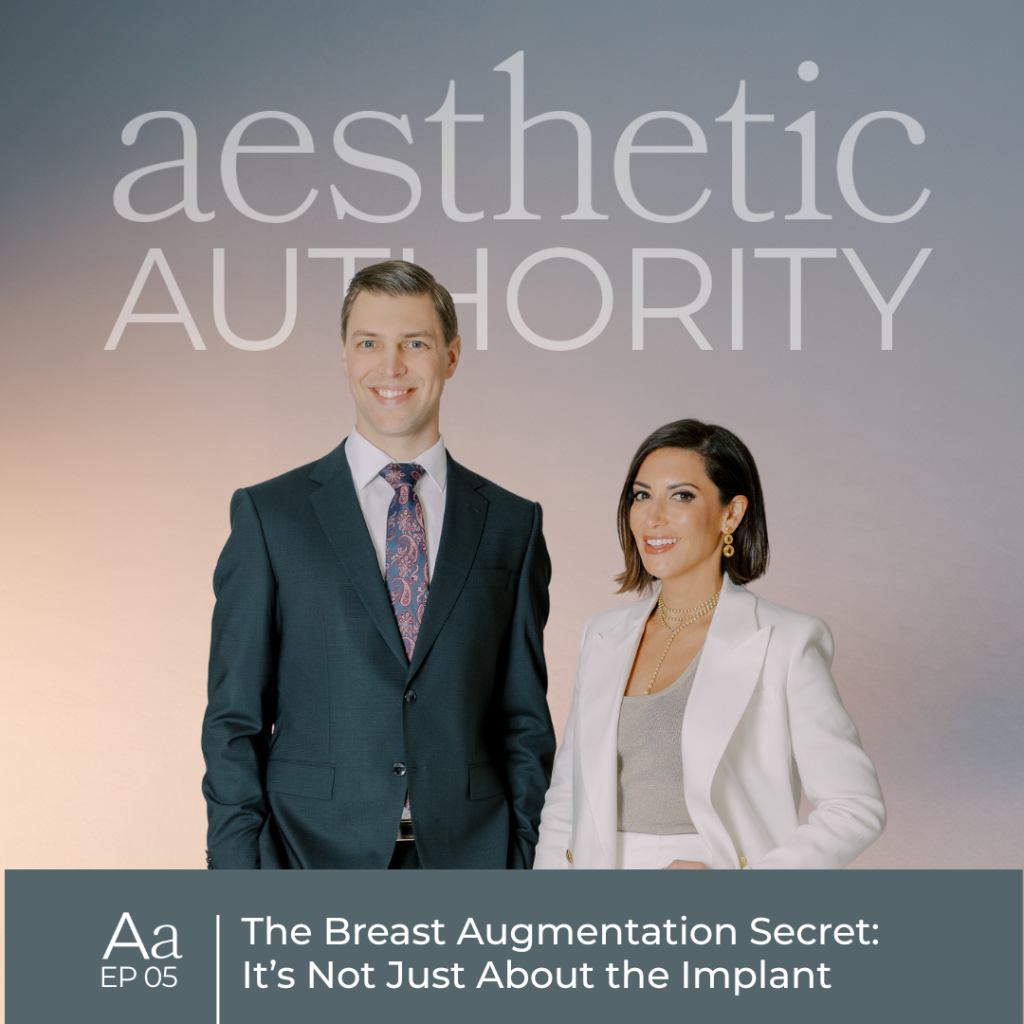
A conversation with Dr. Ashley Amalfi and Dr. Peter Krasniak
Breast augmentation remains one of the most requested procedures in aesthetic surgery, and also one of the most transformed. What patients experienced decades ago bears little resemblance to today’s options. Understanding this evolution helps explain why so many women are now choosing Preservé™, our newest and most innovative augmentation technique.
Where We Started: Complete Submuscular Placement
Twenty years ago, the standard approach placed implants completely beneath the chest muscle. This wasn’t a stylistic choice, it addressed real limitations in implant technology.
“The devices weren’t that great,” Dr. Amalfi explains. “They were wrinkly or rippley, and patients didn’t like the way that looked. We didn’t have any other way to control the position, so plastic surgeons would use the muscle to control exactly where it was and cover it up.”
This solution created an unexpected long-term problem. Chest muscles remain dynamically active throughout life, and that ongoing muscle function gradually pushes implants downward and outward. Over years and decades, this migration widened the space between breasts and shifted implants from their original position.
“Women twenty or thirty years ago probably didn’t work out and lift weights the way women do now,” Dr. Amalfi notes. “Anyone who had that implant under their muscle and is now lifting weights or even going to Pilates and yoga—those implants are going exactly in the wrong direction.”
The result? Many women experienced pain, discomfort, and dissatisfaction with implants that no longer looked or felt the way they originally did.
The Subglandular Alternative—And Its Own Challenges
Before complete submuscular placement became standard, some surgeons placed implants entirely above the muscle, directly beneath breast tissue. This subglandular approach felt more natural and removed muscle movement from the equation entirely.
However, the implant technology of that era created different problems. Third-generation silicone implants and saline devices frequently caused capsular contracture (hardened scar tissue forming around the implant) along with persistent rippling issues.
The Dual Plane Compromise
Around fifteen to twenty years ago, surgeons developed what’s called dual plane placement—essentially splitting the difference between complete submuscular and subglandular approaches.
“You’re trying to have muscle coverage of the top of the implant so you don’t see that rippling,” Dr. Krasniak explains. “Then the bottom of the implant, you release the muscle so it slides out and you get roundness at the bottom.”
This became the standard training approach for plastic surgeons for years—popularized publicly when celebrities described their augmentations as being “half under the muscle.” While technically imprecise, this description captured the concept well.
Yet even partial muscle coverage retained some of the original problems. “The muscle still has a force,” Dr. Amalfi observes. “It might be a little bit less and different than when it’s completely under the muscle, but even partially under the muscle over time can cause those same problems—implants moving out, widening of the cleavage.”
Patients also reported an unusual side effect: visible movement or deformation when flexing chest muscles during exercise. Many described the sensation as strange or uncomfortable.
Today, patients who received dual plane augmentation years ago sometimes return for their second set of implants. “I have that conversation with patients,” Dr. Krasniak shares. “You’ve lived with these implants for five or ten years, they’re under your muscle right now. I have a technique that could change that for you—but does this bother you?”
Importantly, if a patient’s dual plane implants are functioning well without issues, there’s no need to change the approach. “If patients are happy and it looks great and feels great, there’s no reason to change something that’s working.”
Sixth-Generation Silicone: A Genuine Breakthrough
While placement techniques evolved, implant technology itself underwent dramatic transformation. Today’s sixth-generation silicone implants represent a fundamentally different product from their predecessors—not merely an incremental update.
“This isn’t improvement like adding a new profile,” Dr. Krasniak emphasizes. “The shell of the implant is completely different. You look at them side by side, and it’s a world of difference. You feel them, and it’s a world of difference.”
In consultations, patients can directly compare fifth-generation and sixth-generation implants. “More than ten times out of ten, patients say these new ones feel so much better,” he reports. “It really is different—it’s not like a new company putting a stamp on the same thing. It’s bioengineering,” Dr. Amalfi confirms.
This advancement matters partly because of the rigorous regulatory process implants undergo. “This might be the most studied device in medicine,” she notes. “We’re now on the sixth generation, which means implants have come through FDA review for the sixth time.”
The improved gel consistency—often compared to a “gummy bear” texture—significantly reduces rippling and wrinkling while creating movement that mimics natural tissue.
The Science Behind Reduced Complications
Perhaps the most significant advancement addresses capsular contracture, the scar tissue formation that plagued earlier implant generations.
“The newest implants have dedicated the majority of deep research—from mouse models through humans—to look at how we can decrease that,” Dr. Krasniak explains. “It’s based on nano-texturing: tiny speckles on the implant surface that prevent your body from recognizing and responding to it.”
This bioengineering breakthrough allows implants to work with the body’s natural response rather than triggering the inflammatory reaction that created scar tissue in earlier devices.
Subfascial Placement: The New Standard
These improved implants have enabled a new placement technique: subfascial breast augmentation, now used for the majority of augmentation patients.
Rather than placing implants beneath the muscle, subfascial technique positions them above the pectoralis muscle but beneath a thin, strong layer of connective tissue called fascia. “We lift up that layer and place the implant underneath it,” Dr. Krasniak explains. “It adds a little support and protects the implant theoretically from the breast tissue itself.”
MRI studies confirm this distinct anatomical plane exists and provides meaningful benefits compared to older subglandular techniques.
The results speak for themselves: “They look better, they feel better. The results overall using these implants and this advanced technique are really superior,” shares Dr. Amalfi. “Most importantly, they don’t move. They don’t contract. They don’t migrate over time, and they feel really soft.”
Years of patient outcomes now support what the technology promised. “We see our patients years out, and there is no scar tissue formation. They look beautiful. They stay soft. The proof is there in the results.”
Introducing Preservé™: Minimally Invasive Innovation
Building on these technological advances, Preservé™ represents the newest evolution in breast augmentation—genuinely new technology to the United States that dramatically reduces recovery time.
“This is brand new technology that allows us to, in the most minimally invasive way, put in a breast implant on top of the muscle with almost no downtime,” explains Dr. Amalfi. “People are taking one day off.”
The technique places implants through an extremely small incision using specialized tools first introduced to this country within the past six to eight months. This isn’t simply a smaller version of traditional techniques—it represents a genuinely different approach.
Who Benefits Most from Preservé™
Preservé™ isn’t universally appropriate for every patient, but for the right candidates, it offers remarkable advantages.
Implant Size Considerations: Because the implant must pass through a small tunnel-like opening, Preservé™ works best for implants under 315cc—a modest, natural-looking size. Patients seeking larger implants will need traditional placement techniques.
Active Lifestyles: For patients concerned about extended recovery interfering with fitness routines, work responsibilities, or childcare duties, Preservé™ offers significant advantages. “Our busy professionals and busy moms who don’t have a lot of childcare support—this is just taking the country by storm.”
Recovery-Focused Patients: Those specifically worried about downtime, pain management, or anesthesia concerns find this approach particularly appealing.
The Recovery Experience
The contrast between Preservé™ recovery and traditional augmentation recovery is striking.
With Preservé™, most patients require just one day of rest—time for anesthesia to fully clear their system and for initial healing to begin. “The next day, I tell them take one day off,” Dr. Amalfi explains. “One day where you have help with your kids, you’re not at your busy job, and you’re really just resting.”
Patients typically avoid heavy lifting or gym activities for about one week, compared to the traditional three-week restriction period. “One week is still game-changing,” notes Dr. Krasniak. “It’s more than half a third of the recovery time.”
Pain management differs dramatically as well. Many patients need nothing stronger than over-the-counter Tylenol, and full range of motion often returns within minutes of surgery completion. “Our patient yesterday was raising her hands in recovery,” Dr. Amalfi shares. “They go from the office to dinner.”
This dramatic reduction in discomfort stems from the technique’s minimally invasive nature. Rather than cutting through tissue and blood vessels—which can cause bleeding and inflammation—Preservé™ creates a stretched pocket for the implant, significantly reducing surgical trauma.
The Consultation Experience: More Options Than Ever
Today’s breast augmentation consultation offers unprecedented personalization. Beyond simply choosing implant size, patients now consider:
Implant Profiles: From low-profile options for patients who want subtle enhancement to ultra-high-profile choices for more pronounced augmentation—with every gradation in between.
Gel Consistency and Movement: Some implants provide rounder, fuller upper pole projection, while newer ergonomic options move more naturally with body position, creating an authentic teardrop shape when standing.
3D Virtual Imaging: Using patients’ actual photographs, our practice can simulate different augmentation outcomes—showing potential results for Preservé™, traditional augmentation, or combination procedures like breast lift.
“For our visual learners, this has been a really cool tool to help them feel empowered to make a decision,” Dr. Amalfi explains. “It’s not just an animation—it’s your skin, your actual features. It helps ground the discussion in reality.”
Perhaps most importantly, this technology helps patients understand that requesting a specific implant size (often based on friends’ experiences or social media research) doesn’t guarantee similar results. “That implant on you is going to look completely different than on this model person,” Dr. Krasniak notes. “This technology helps patients understand—let’s try that size and see if it’s too much or not enough for your body.”
Patient-Centered Decision Making
What distinguishes our approach is genuine commitment to patient autonomy in decision-making.
“I don’t think we tell patients, ‘You should have this because it will look really good,'” Dr. Amalfi emphasizes. “We really are listening to what your goals are—do you want to look natural? Do you want people to barely notice? We help guide you, but we let you make that decision. That’s really empowering.”
This philosophy extends across the full spectrum of patient goals. “There’s a full spectrum of breast augmentation patients—some want everyone to know they’ve had augmentation, others want complete subtlety even in a bathing suit. We have implants for that entire range.”
Debunking the “Ten-Year Replacement” Myth
One of the most persistent misconceptions involves implant longevity. Many patients believe implants must be replaced every decade regardless of condition.
“I say it’s false,” states Dr. Krasniak directly. “Implants aren’t meant to be permanent devices—you’re going to need another surgery at some point in your life to address your breast implants, and it’s important to know that. But it’s not automatic every ten years.”
Modern FDA guidelines recommend ultrasound imaging around seven years post-implantation as a quick, cost-effective way to verify implant integrity. If imaging shows healthy, intact implants, no intervention is necessary.
The Real Reasons for Implant Exchange
Rather than an arbitrary timeline, life changes typically drive decisions about implant exchange:
Natural Life Transitions: The predictable hormonal cycles of a woman’s life—puberty, family building, pregnancy, breastfeeding, and eventually menopause—each bring changes to breast tissue that may prompt reconsideration of implant size or the addition of a breast lift.
Weight Fluctuations: Whether from GLP-1 medications or other causes, significant weight changes affect how breasts look and feel, sometimes prompting patients to reconsider their augmentation.
Simultaneous Procedures: When patients return for a breast lift years after initial augmentation, surgeons often recommend exchanging older-generation implants for current technology during the same surgery. “We’re doing it because we’re there for something else,” Dr. Krasniak explains. “It’s fair—not simply for the sake of the implant.”
Size Reconsideration: Some women who chose larger implants in their twenties or thirties later prefer a smaller profile as their lifestyle or preferences evolve, often combined with a lift to maintain proper positioning.
Understanding Implant Rupture
When implants do rupture, the reality proves far less alarming than many patients fear.
“The rupture rate for almost all devices is about one percent per year, regardless of manufacturer,” Dr. Amalfi explains. Modern implants’ gummy bear-like consistency means that even if a rupture occurs, the silicone remains contained within the surrounding scar tissue capsule rather than migrating elsewhere in the body.
“It’s not going anywhere in your tissue,” she reassures. “It’s certainly not going to make you sick or ill.” While rupture does warrant addressing, similar to any medical device malfunction, it’s not a medical emergency requiring immediate surgery.
The Truth About Longevity
Some implants last remarkably longer than others. Our surgeons have removed implants that were forty years old and found them perfectly intact.
“This woman liked the way she looked since she got them at thirty, and now she’s seventy,” shares Dr. Krasniak. “She’s done with implants—not because there’s an issue, but because that’s her choice. They were perfectly intact; you could read the back of the label.”
This variability underscores why arbitrary replacement schedules make little sense. “If we were doing this every ten years, you would have had three more surgeries you didn’t need.”
Making the Right Decision for Your Body
For women considering breast augmentation—whether for the first time or as a revision of previous surgery—today’s landscape offers unprecedented options tailored to individual goals, lifestyles, and preferences.
Key considerations include:
- Lifestyle demands: How much recovery time can you realistically accommodate?
- Activity level: Do you engage in regular weightlifting, yoga, or other activities that might affect implant positioning over time?
- Aesthetic goals: Do you want subtle enhancement or more dramatic transformation?
- Implant size preferences: Are you interested in Preservé™’s minimally invasive approach, which works best for implants under 315cc?
- Previous implant history: If you’re considering revision surgery, what’s changed about your body, lifestyle, or preferences since your original augmentation?
“The world is open for you now,” emphasizes Dr. Krasniak to patients considering their options. “There are a lot of different options that you have, and if that’s exciting for you, come and talk to us about it.”
To learn more about breast augmentation options, including our innovative Preservé™ technique, or to schedule a consultation with our specialized breast surgery team, contact our Patient Consultants at the historic Lindsay House in Rochester, New York.

Leave a Reply