
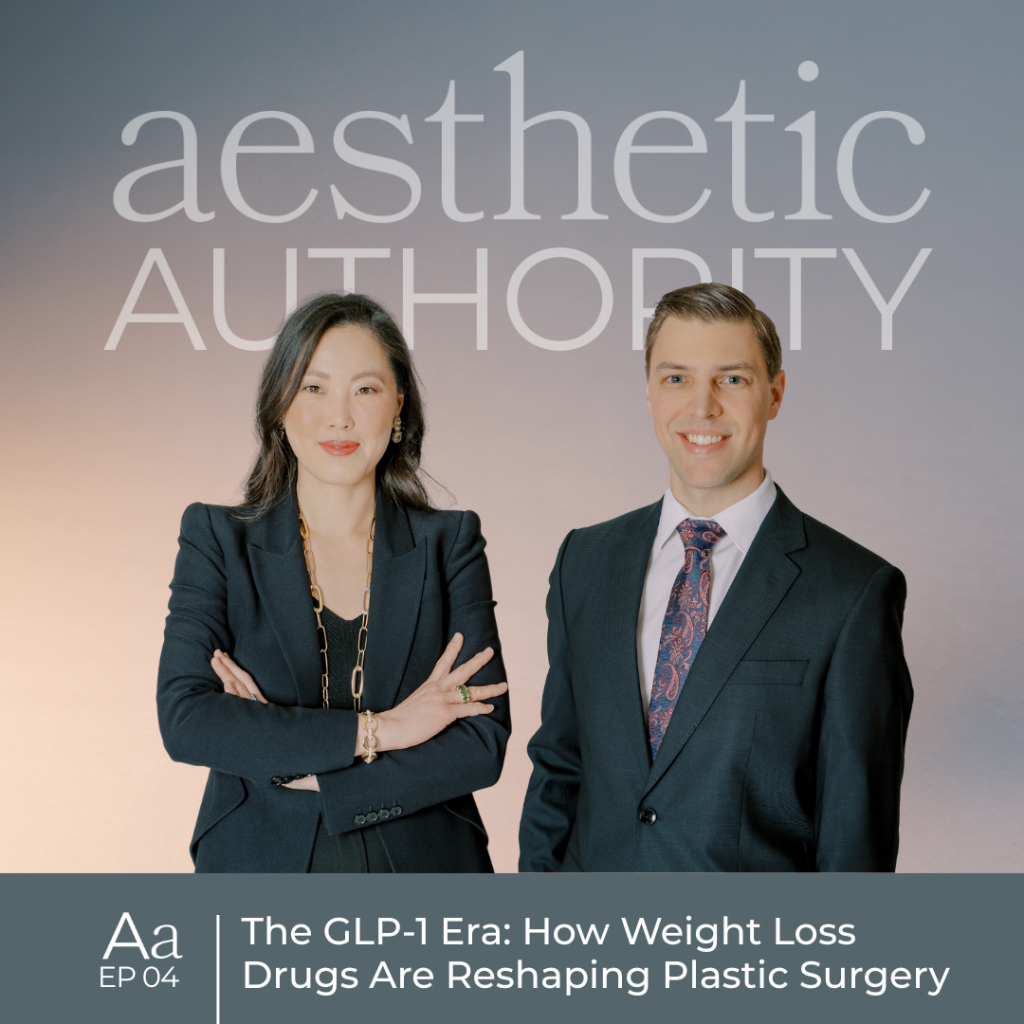
A conversation with Dr. Heather Lee and Dr. Peter Krasniak
The landscape of weight loss has transformed dramatically. GLP-1 medications, such as Ozempic, Wegovy, and Mounjaro, are helping millions achieve weight loss goals that previously seemed impossible. Yet as Dr. Heather Lee and Dr. Peter Krasniak discuss in their revealing conversation, this revolution brings new considerations for anyone contemplating plastic surgery.
A New Patient Journey
“I think it’s a little different for you and me based on where we are,” Dr. Krasniak begins, acknowledging the distinct perspectives he and Dr. Lee bring as body and facial plastic surgeons, respectively.
While GLP-1 medications were originally developed for diabetes management, their profound weight loss effects have created an entirely new category of aesthetic patients. The timeline matters: the medications gained momentum around 2021-2022, but because significant weight loss takes time, the surge of patients seeking surgical solutions emerged only in the past two to three years.
“I remember seeing my first patients on these medications probably pre-COVID,” Dr. Lee recalls. “But really it was post-COVID that we noticed a huge increase.”
Three Distinct Patient Categories
Dr. Krasniak identifies three types of patients arriving at the Quatela Center:
The Completed Journey Patient: These individuals have lost substantial weight, sometimes 50, 100, or even 160 pounds, and now confront unexpected loose skin. “Everyone has the things they worry most about,” Dr. Krasniak explains. “For some people, it’s their abdomen. For some people, it’s their arms. For some people, it’s their breasts.”
The Forward-Thinking Planner: Still mid-journey but researching ahead, these patients want to understand what surgical options might eventually help them. While their proactive approach is admirable, the conversation must address a crucial reality: now isn’t the time for surgery.
The Struggling Weight Loss Patient: After years or decades of trying various diets and exercise programs, these patients have managed only modest results—perhaps 5 or 10 pounds that inevitably return. They don’t qualify for bariatric surgery but need to lose an additional 20 to 40 pounds. For them, GLP-1 medications represent a new possibility.
The Surprise of “Ozempic Face”
Despite widespread media coverage, patients often remain unprepared for the facial changes that accompany significant weight loss.
“I think patients are still a little surprised when they experience it,” Dr. Lee observes. “You look at commercials showing people shedding weight in clothes, but you don’t actually see what’s happening underneath everything.”
The phenomenon known as “Ozempic face” involves more than simple volume loss. Recent studies using CT scans reveal a statistically significant reduction in the superficial midface, the area just below the cheekbones. This deflation affects the periorbital area around the eyes and contributes to increased jowling as descended tissue accumulates along the jawline.
“With any rapid weight loss, which we saw with bariatric surgery patients, there’s a major shift in the volume of fat in the face and body,” Dr. Lee explains. “Specifically in the face, you’re seeing changes in skin collagen and elastin. We think even on a cellular level, the way fat stem cells signal and how they affect fibroblasts, important in wound healing, may be different.”
The speed of weight loss proves particularly problematic. When pounds disappear rapidly, skin cannot adapt to the shrinking framework beneath. The result? Tissue that feels and looks like it has dropped dramatically.
The Emotional Complexity
For many patients, achieving their weight loss goals creates an unexpected emotional challenge.
“I think some people expect it, but other patients find it really emotionally taxing,” Dr. Lee reflects. “They’re thinking, ‘I look as good as I’ve ever felt. I’m off my diabetes medications. My energy’s never been better. But I look like my grandmother.’ That’s really, really hard for patients.”
This disconnect, between feeling physically healthier than ever while appearing older than expected, drives many to seek surgical solutions. Yet not everyone views the changes negatively.
“Some patients are quite happy with the fullness of their face coming down,” Dr. Lee notes. “They like seeing their cheekbones emerge, not feeling as rounded and puffy.” This variation in response means treatment remains highly individualized, guided by each patient’s aesthetic goals rather than a standardized approach.
The Body Perspective
From Dr. Krasniak’s vantage point treating body concerns, the pattern of change proves remarkably predictable, even if individual responses vary.
“The number one area patients come in for, and this is male and female, is the abdomen,” he explains. “That’s where they first noticed the extra weight, so once it’s gone, they notice the loose skin because it’s something they’ve been focusing on.”
The arms typically rank second, particularly as warm weather approaches. “During summer, everyone wants to wear short sleeves. If you can’t, it’s noticeable every single day. People feel like they have to hide their extra skin by wearing long sleeves year-round.”
For women, the challenge often extends continuously from the upper arm across the lateral chest into the breast tissue. “It’s like a very defined, contiguous area of laxity that sometimes I have to address all at once,” Dr. Krasniak observes. “Once you have that weight loss, it becomes an entire aesthetic unit.”
The thighs, while consistently on patients’ lists, typically rank last. Not because the concern is minor, but because shorts and pants more easily conceal the issue as compared to the arms or abdomen.
Beyond Simple Skin Removal
A common misconception holds that post-weight-loss surgery simply involves removing excess skin. The reality proves far more nuanced.
“Patients that haven’t had weight loss and come in for abdominal surgery, maybe post-pregnancy, almost always have excess fatty tissue in areas like the lower back or love handles,” Dr. Krasniak explains. “I’m doing liposuction as an adjunct, probably 95 to 98 percent of the time.”
For weight loss patients? That number drops to 50 or 60 percent.
“They’re really just deflated,” he continues. “Sometimes there are pesky areas that still bother them, so we do some liposuction to tailor those. But compared to 500 or 600 ccs of fat from a patient who hasn’t had weight loss, it’s like 200 ccs, because it looks bad when the skin’s all loose, but when you tighten the skin, there’s really not a whole lot of volume there.”
This distinction extends to incision planning. Patients who’ve lost more than 100 pounds often require what’s called a Fleur-de-Lis abdominoplasty—two incisions forming a T-shape to address both vertical and horizontal excess. “That’s the maximum amount of skin I can remove both vertically and horizontally,” Dr. Krasniak notes. “For the amount of skin we’re trying to remove, this is what’s necessary.”
The Critical Question: When Is the Right Time?
Perhaps no question matters more than timing. Patients excited about their weight loss progress naturally want to address loose skin immediately. Yet both surgeons emphasize the importance of waiting.
“The very first thing when any patient with any amount of weight loss comes into my office, I always say congratulations,” Dr. Krasniak begins. “This is something they’ve been working on probably for a very long time. It’s an accomplishment, and they’re doing it not because they want surgery, they’re doing it because they want to live a healthier life.”
After celebration comes the practical discussion. Most patients arrive with a goal weight in mind, often determined in consultation with the physician prescribing their medication.
“Where are you now compared to that number?” Dr. Krasniak asks patients. “Are you five to ten pounds off? Great, let’s talk about surgery. But if you’re 50 pounds away, we can have a surgical discussion, but the timeframe will be different. You need to reach your goal first.”
The standard across both facial and body surgery: patients should be stable at their goal weight for at least six months before proceeding with surgery.
“I want you to prove to yourself that this change you’ve made is sustainable,” Dr. Krasniak emphasizes. “Some people reach their goal weight while still on the medication, haven’t backed off the dose yet, and are still losing. That’s not stable.”
Additional factors matter beyond the number on the scale: How long have they been on the medication? What’s their current dosage? How long at maintenance dose? All these elements inform the surgical timing decision.
The Healing Consideration
Recent surgical experience has revealed an unexpected challenge with GLP-1 patients: wound healing delays.
“I’ve been doing this just under a decade, and I’ve seen more wound healing issues than I ever have,” Dr. Lee shares candidly. “Is that from GLP-1 usage specifically, or is it because patients have been severely calorie-restricted? Even patients who are very aggressive about protein intake and strength training—I’m seeing wound healing delays later than expected.”
This observation has prompted Dr. Lee to reconsider her approach. “It doesn’t really make sense if they’re reaching protein requirements,” she reflects. “I think there’s something happening on the cellular level with how these medications affect fat cells and fibroblasts.”
These concerns have practical implications. While recent anesthesia guidelines suggest stopping GLP-1 medications 24 hours before surgery, Dr. Lee takes a more conservative approach, considering not just surgical safety but optimal healing conditions. She’s exploring adjunct therapies like hyperbaric oxygen to support the recovery process.
The Comprehensive Approach
One significant advantage at the Quatela Center: patients experiencing both facial and body changes can address all concerns in one place.
“Having the opportunity to provide comprehensive care for a total weight loss patient in one location has probably helped these patients a lot,” Dr. Krasniak observes.
He describes a recent shared patient: “I did an abdominoplasty, and about six months later, they were in the operating room with Dr. Lee for a facelift. This is probably going to happen more and more.”
The coordination between facial and body surgery requires thoughtful planning. Dr. Lee considers factors like surgical positioning; she doesn’t want patients who’ve just undergone cheek augmentation with implants lying prone for a back procedure too soon. Conversely, extensive body contouring with liposuction involves significant fluid shifts that could affect facial surgery outcomes.
“I want to figure out what your surgical plan is, what mine is, what the patient’s priority is, and then how we work together,” Dr. Lee explains. “It’s always in the patient’s best interest.”
Both surgeons recommend six-month intervals between major surgeries, whether combining facial and body procedures or staging multiple body procedures. This timeline ensures complete healing before subjecting the body to another physiologic stressor.
What You Can’t Prevent (And What You Might)
The question arises frequently: Can anything prevent the need for surgery after significant weight loss?
“I think it’s really tough,” Dr. Lee responds honestly. “If you’re younger with good skin tone and don’t carry much weight in your face, especially if you’re losing weight gradually, maybe you can mitigate some effects. Gradual loss gives your body a chance to adapt.”
Yet magnitude matters more than pace. “If you’re losing 50-plus pounds, you’re going to notice areas no matter how gradual the weight loss,” Dr. Krasniak adds. “And sometimes you’re okay with that, sometimes you’re not.”
Some patients have inquired about “collagen banking,” building collagen reserves before starting GLP-1 medications through treatments like biostimulatory fillers. “I don’t know how significant that is,” Dr. Lee admits. “I honestly don’t know. As data emerges showing what’s beneficial and what’s not, we’ll be able to advise patients more successfully.”
The Natural Result
What distinguishes the Quatela approach? An emphasis on natural-looking outcomes that honor each patient’s individual aesthetic.
“Some patients like the angularity and contour they’ve gained; they don’t feel as rounded and puffy,” Dr. Lee explains. “We talk about their aesthetic goals and see what we can do to reach them. It’s still patient-directed.”
This philosophy extends to volume restoration. While many post-weight-loss patients benefit from volume replacement through fillers or fat grafting, the decision depends on the individual’s desired outcome. Some patients want to maintain their newly defined features; others seek to soften hollowing that aged their appearance.
“Volume restoration is a big part of this,” Dr. Lee notes. “But it’s about achieving a restored, natural look—not simply replacing everything that was lost.”
Looking Forward
As these medications evolve and their usage expands, both surgeons anticipate significant changes ahead.
“They’re coming out with newer GLP-1 medications targeting more receptors, sometimes showing more dramatic weight loss,” Dr. Lee observes. “You’re going to see more applications—sleep apnea, metabolic diseases like fatty liver, addiction medicine. More and more people will be using these medications, maybe not always for massive weight loss.”
The impact extends beyond healthcare. “You’re seeing entire industries being changed—food and restaurant industries,” Dr. Lee notes. “The impact is incredible.”
From an aesthetic standpoint, the priority remains understanding what’s physiologically happening and meeting patient needs safely. Concerns about muscle wasting may drive development of medications with fewer such side effects. The biology underlying these changes will likely be clarified within the next five years, potentially revealing new approaches to optimize surgical outcomes.
“There’s a lot of interest in whether we should use biostimulatory molecules in the face as preparation for GLP-1 usage,” Dr. Lee mentions. “I honestly don’t know how significant that is. The data will show us what’s working and what’s not, and we’ll be able to advise and lead our patients more successfully.”
The Essential Wisdom
What emerges from this conversation is a nuanced understanding of how GLP-1 medications have transformed, and continue to transform, the aesthetic surgery landscape.
Key insights for anyone on this journey:
- Celebrate your weight loss achievement, but understand that loose skin after significant weight loss is normal and expected
- Timing matters: reach your goal weight and maintain stability for at least six months before considering surgery
- Healing may take longer than with patients who haven’t used these medications; factor this into your planning
- Not everyone experiences dramatic facial changes; individual responses vary significantly
- Some aesthetic changes might actually align with your goals; preserved angularity and definition can be desirable
- Comprehensive planning that addresses both face and body creates the most harmonious results
- Working with surgeons experienced in post-weight-loss reconstruction ensures realistic expectations and optimal outcomes
As Dr. Krasniak emphasizes when welcoming new patients: “Congratulations—this is an accomplishment. You’re doing this because you want to live a healthier life, and that’s awesome.”
The loose skin that may follow represents not a failure but evidence of success. With thoughtful timing, expert surgical technique, and realistic expectations, that success can be complemented by aesthetic results that help you look as good as you feel.

Leave a Reply